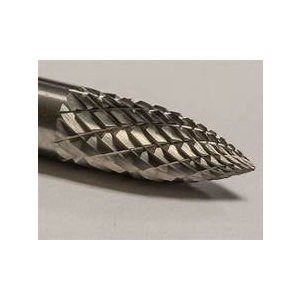
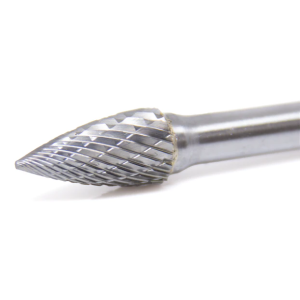
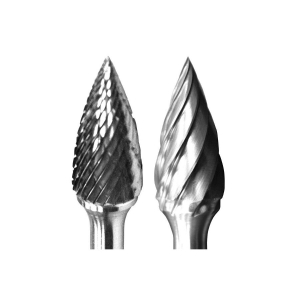
SG Series Aluma-Cut tree burrs with pointed end — corner and detail access in soft metals
The G series is the F series with the radius taken off the nose. That pointed tip is the reason it exists: it goes where nothing else reaches — the acute inside corner of a weld, the apex of a V-groove, the sharp relief detail no rounded burr can enter. Ground in Aluma-Cut geometry with wide single-cut flutes that eject soft chips instead of packing them, so the point stays sharp and the burr keeps cutting. Solid tungsten carbide, manufactured in our USA facility and sold direct at factory pricing.
SG
series designation
Aluma-Cut
single-cut flute
USA
manufactured
Key features & benefits
Solid tungsten carbide throughout
A fine point is only as good as the material behind it. Solid carbide — not carbide-tipped, not HSS — keeps the tip geometry intact through repeated corner work.
Aluma-Cut flutes reject aluminum loading
Soft chips pack fastest at the tip, where flute volume is smallest. Aluma-Cut's wide, deeply relieved single-cut flute clears the chip before it can weld to the carbide.
Pointed tip reaches acute corners
The tapered point enters angles a radius-end tree or an oval simply cannot reach — V-groove apexes, inside weld corners, and fine relief detail.
Factory-direct wholesale pricing
Manufacturer pricing on every order, from one burr to a production run. No distributor sits between our grinding room and your die grinder.
Professional resharpening service
Solid carbide SG burrs can be professionally resharpened for 3 to 5 additional use cycles, restoring the point and dramatically reducing cost per part.
Same & next day shipping
In-stock SG heads ship same or next business day from our USA facility — no long lead times on consumable tooling.
Materials & applications
Material type
Recommended cut style
Key applications
Aluminum & aluminum alloys
aluma-cut
Porting, deburring, shaping, mold & die cleanup
Brass & bronze
aluma-cut
Valve work, fitting deburr, decorative shaping
Copper
aluma-cut
Busbar dressing, tube prep, sculpture & art metal
Magnesium & zinc
aluma-cut
Die-cast flash removal, gate cleanup
Plastics, acrylic & composites
aluma-cutsingle cut
Trimming, edge finishing, fitting
Wood & MDF
aluma-cut
Carving, relief work, shaping, inlay pockets
Advantages vs other cut types
G series — tree, pointed end
vs
F series — tree, radius end
Enters acute corners a radius cannot reach
corner access
Rounded nose stops short of the true corner
Cuts sharp V-groove apexes and relief detail
detail work
Leaves a radius at the bottom of every groove
Point starts a cut exactly where you place it
precision
Radius wanders slightly on entry
Ideal for inside weld corners and fine carving
weld corners
Better for the run, weaker at the corner
Tapered body still opens the groove walls
versatility
Same tapered body — equal on wall work
Who should use G Series Tree Shape Pointed End burrs
Aluminum fabricators
Deburring, weld dressing & edge prep on plate and extrusion
Aerospace & automotive
Alloy component finishing, port work & bracket cleanup
Copper, brass & wood carving with fine surface control
Woodworkers & carvers
Relief carving, pocket work & inlay shaping in hardwood
Safety guidelines
Never plunge a pointed tip at full RPM
The G series tip is its most fragile feature and its whole reason for being. Plunging at speed or loading the point sideways will chip it. Ease in, cut with the flank of the taper wherever possible, and match RPM to head diameter — larger heads turn far slower. Check the RPM chart before operating.
Never run Aluma-Cut on hardened or ferrous steel
The wide-flute single-cut geometry that clears aluminum chips so cleanly has no edge support against hardened steel. Running an Aluma-Cut burr on steel chips the cutting edge within seconds and can fracture the head. Use a double-cut burr on ferrous material — every time.
Full face shield required for all grinding operations
Aluminum swarf leaves the burr as long, hot, curling chips travelling at high velocity. A full face shield — not just safety glasses — is required for all die grinder work.
Inspect burr before every use
Visually inspect the head and shank before inserting into the grinder. Any crack, chip, or bent shank is grounds for immediate discard — a damaged carbide burr at speed is an ejection and injury risk.
Secure workpiece before grinding
Always clamp or fixture the workpiece before starting. Soft aluminum stock walks under burr pressure far more readily than steel, and an unsecured part is a leading cause of die grinder injuries.
Eye & hearing protection always
Wear safety glasses and hearing protection on all die grinder operations regardless of duration or head size.
How to choose the right shape
G series
Tree pointed end
Acute corners, V-groove apexes, sharp relief and detail work
The only shape that reaches a true inside corner
F series
Tree radius end
Deep grooves, weld root access, contoured channels
Choose F for travelling along a groove — the tip lasts longer
Choose E when the corner must be softened rather than sharpened
Frequently asked questions
When should I use a G series pointed tree burr instead of an F series?
Use the G series when you need to reach the actual corner of a feature. Its pointed nose enters acute inside angles, V-groove apexes and fine relief detail that a radius-end tree simply cannot get into. For everything else — running along a groove floor, opening a weld root, general contouring — the F series is the better tool: the rounded nose does not dig, does not grab on entry, and the tip survives lateral load far longer than a fine point does.
How do I stop the pointed tip from chipping?
Three habits prevent almost all G series tip failures. First, never plunge straight in at full RPM — ease the tip into contact and let it start its own cut. Second, cut with the flank of the taper whenever the geometry allows, and save the point for the corner it was made for. Third, match RPM to head diameter rather than running everything at the grinder's top speed. Lateral shock load at the tip, not wear, is what chips carbide points.
Will an Aluma-Cut G series burr work on plastics and wood?
Yes — Aluma-Cut geometry works very well on plastics, acrylic, composites, hardwood and MDF. The wide single-cut flutes clear soft, stringy swarf that would clog a double-cut burr immediately, and the pointed tip is excellent for relief carving and detail pockets. Keep the RPM moderate on thermoplastics so the chip does not melt and re-weld to the flute. For guidance on a specific material call 1-800-645-1679.
Why buy from Carbide Burrs Direct
USA-manufactured SG series Aluma-Cut burrs — direct from the factory
Solid tungsten carbide, single-cut Aluma-Cut geometry, ground and finished in our USA facility.
Purpose-ground Aluma-Cut flutes — no chip packing, no loading on aluminum
Full tree pointed end range in stock — every head diameter and length of cut
Factory-direct pricing — no distributor markup on any order
Professional resharpening service — 3 to 5 additional use cycles per burr
1/4" & 1/8" shank sizes — die grinder to precision rotary tool coverage
Same or next day shipping on in-stock items from our USA facility