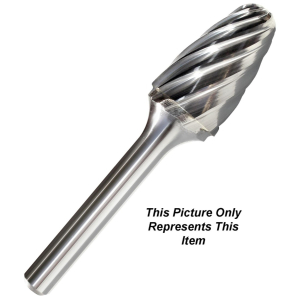
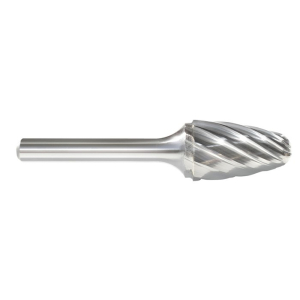
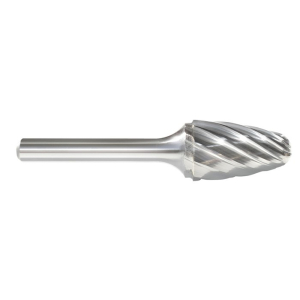
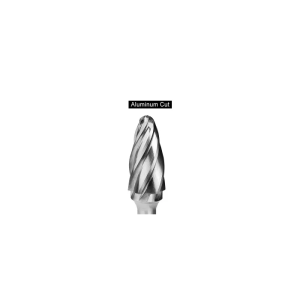
SF Series Aluma-Cut tree burrs with radius end — groove and contour work in soft metals
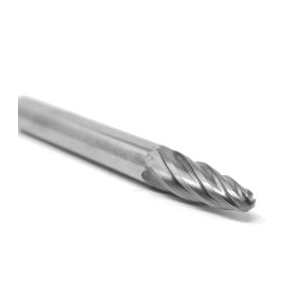
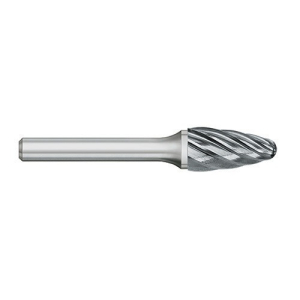
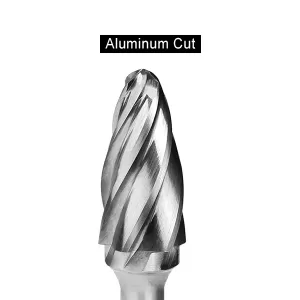
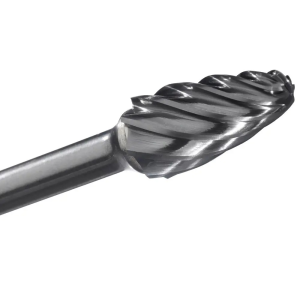
The F series tree burr tapers to a rounded nose, and that single detail is what makes it the groove and channel tool. The radius end lets you drop into a slot or weld root and follow it without the tip biting a corner into the floor, while the tapered body opens the walls on the way out. Ground in Aluma-Cut geometry — wide single-cut flutes that eject aluminum chips rather than packing them — so the burr keeps cutting instead of loading up. Solid tungsten carbide, manufactured in our USA facility, sold factory-direct.
SF
series designation
Aluma-Cut
single-cut flute
USA
manufactured
Key features & benefits
Solid tungsten carbide throughout
Solid carbide from shank to nose — not carbide-tipped, not HSS. The tapered tree profile puts leverage on the tip, and only solid carbide holds its geometry under that load.
Aluma-Cut flutes reject aluminum loading
Wide, sharply relieved single-cut flutes give the soft chip somewhere to go. No packing at the tip, no smearing in the groove, no stopping to pick swarf out of the flutes.
Radius end follows a groove without gouging
The rounded nose rides the floor of a slot or weld root instead of cornering into it. That is the whole difference between a clean channel and a series of dig marks.
Factory-direct wholesale pricing
Straight from our grinding room to your bench. No distributor margin, and the same factory pricing for a single burr as for a production order.
Professional resharpening service
Solid carbide F series burrs can be professionally resharpened for 3 to 5 additional use cycles — a significant reduction in cost per part over the life of the tool.
Same & next day shipping
In-stock SF heads leave our USA facility same or next business day. Your grinder does not wait on an ocean container.
Materials & applications
Material type
Recommended cut style
Key applications
Aluminum & aluminum alloys
aluma-cut
Porting, deburring, shaping, mold & die cleanup
Brass & bronze
aluma-cut
Valve work, fitting deburr, decorative shaping
Copper
aluma-cut
Busbar dressing, tube prep, sculpture & art metal
Magnesium & zinc
aluma-cut
Die-cast flash removal, gate cleanup
Plastics, acrylic & composites
aluma-cutsingle cut
Trimming, edge finishing, fitting
Wood & MDF
aluma-cut
Carving, relief work, shaping, inlay pockets
Advantages vs other cut types
F series — tree, radius end
vs
G series — tree, pointed end
Rounded nose rides a groove floor cleanly
groove work
Sharp tip digs into the floor under pressure
Radiused corners in slots and channels
corner profile
Cuts a hard, stress-raising sharp corner
Forgiving on entry — less grab
control
Point loads instantly — grabs on entry
Weld root and fillet access without gouging
weld prep
Reaches deeper, but risks undercutting the root
Longer tip life — no fragile point
durability
Fine point chips first under lateral load
Who should use F Series Tree Shape Radius End burrs
Aluminum fabricators
Deburring, weld dressing & edge prep on plate and extrusion
Aerospace & automotive
Alloy component finishing, port work & bracket cleanup
Copper, brass & wood carving with fine surface control
Woodworkers & carvers
Relief carving, pocket work & inlay shaping in hardwood
Safety guidelines
Reduce RPM before loading the tip laterally
Tree burrs are worked side-on, and lateral load at the tip is what breaks them. Match RPM to head diameter — large heads turn far slower than small ones — and ease into the cut rather than plunging. Consult the RPM chart for each head size before operating.
Never run Aluma-Cut on hardened or ferrous steel
The wide-flute single-cut geometry that clears aluminum chips so cleanly has no edge support against hardened steel. Running an Aluma-Cut burr on steel chips the cutting edge within seconds and can fracture the head. Use a double-cut burr on ferrous material — every time.
Full face shield required for all grinding operations
Aluminum swarf leaves the burr as long, hot, curling chips travelling at high velocity. A full face shield — not just safety glasses — is required for all die grinder work.
Inspect burr before every use
Visually inspect the head and shank before inserting into the grinder. Any crack, chip, or bent shank is grounds for immediate discard — a damaged carbide burr at speed is an ejection and injury risk.
Secure workpiece before grinding
Always clamp or fixture the workpiece before starting. Soft aluminum stock walks under burr pressure far more readily than steel, and an unsecured part is a leading cause of die grinder injuries.
Eye & hearing protection always
Wear safety glasses and hearing protection on all die grinder operations regardless of duration or head size.
How to choose the right shape
F series
Tree radius end
Deep grooves, weld root access, contoured channels, port throats
Essential for weld prep — reaches the root without gouging the floor
G series
Tree pointed end
Tight corners, acute angles, sharp-detail relief work
Choose G when you need the very corner of a feature
Choose L when the wall angle matters more than the depth
Frequently asked questions
What is the difference between the F series and the G series tree burr?
Both are tapered tree shapes; the difference is the nose. The F series ends in a radius, the G series in a point. Use the F series whenever the tool has to travel along the floor of a groove, slot or weld root — the rounded nose rides the surface and leaves a radiused, stress-free corner. Use the G series only when you need to reach into an acute corner that the radius cannot enter. As a rule, reach for F first: it is more forgiving on entry, less prone to grabbing, and the tip lasts considerably longer under lateral load.
Can I use an SF Aluma-Cut burr on steel?
No. Aluma-Cut geometry is ground specifically for aluminum, brass, copper, magnesium, plastics and wood. The wide single-cut flute that clears soft chips so well leaves the cutting edge unsupported against hard ferrous material, and running it on steel will chip the edge within seconds and can fracture the head. For steel, stainless and cast iron use a double-cut, Xo-Cut or iron-cut F series burr instead — we stock all of them.
What RPM should I run an SF Aluma-Cut burr at?
RPM depends on head diameter. As a general guide: 1/4-inch heads run at 50,000 to 60,000 RPM; 1/2-inch heads at 25,000 to 35,000 RPM; 3/4-inch heads at 15,000 to 20,000 RPM; and 1-inch heads at 10,000 to 15,000 RPM. Larger heads cover more surface per revolution, so they must turn slower to stay in a safe cutting-speed range. Always reduce RPM when you step up a head size and never exceed your grinder's rated speed. Call 1-800-645-1679 if you need help matching a burr to your tool.
Why buy from Carbide Burrs Direct
USA-manufactured SF series Aluma-Cut burrs — direct from the factory
Solid tungsten carbide, single-cut Aluma-Cut geometry, ground and finished in our USA facility.
Purpose-ground Aluma-Cut flutes — no chip packing, no loading on aluminum
Full tree radius end range in stock — every head diameter and length of cut
Factory-direct pricing — no distributor markup on any order
Professional resharpening service — 3 to 5 additional use cycles per burr
1/4" & 1/8" shank sizes — die grinder to precision rotary tool coverage
Same or next day shipping on in-stock items from our USA facility